




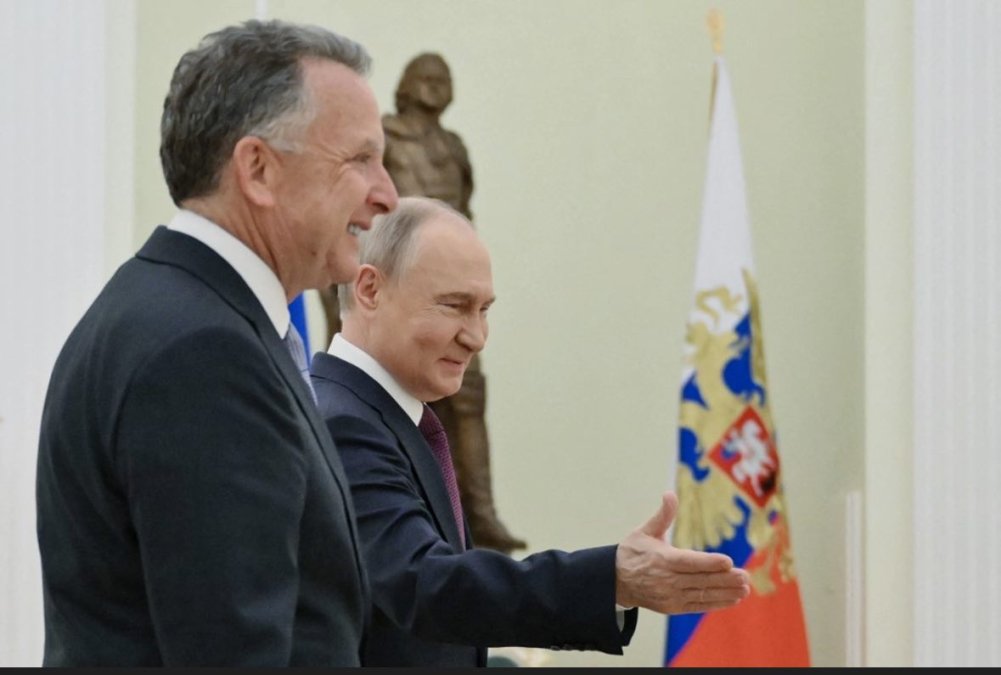
Diplomatic Deadlock at the Kremlin
With the failure of intensive negotiations at the Kremlin and the simultaneous escalation of battles in the Black Sea, the Russia-Ukraine crisis has entered a stage where diplomacy behind closed doors has run out of breath, and the war targeting energy infrastructure has become the determining factor for the future course of the conflict. Suicide drones have taken on the role of failed diplomats. Diplomacy in Moscow’s closed rooms has reached a deadlock, but in the open waters, the war has entered a new phase of energy infrastructure destruction, with suicide drones replacing diplomatic handshakes. A long and intensive meeting at the Kremlin between Russian President Vladimir Putin and senior U.S. envoys Steve Witkoff and Jared Kushner ended without reaching an agreement to end the war, although a senior Russian official described these talks as useful and constructive.
Yuri Ushakov, Kremlin’s foreign policy aide and attendee at the meeting, emphasized that the issue of territory has been one of the most sensitive topics for Moscow, but the two parties have not yet reached a compromise. Ushakov told reporters in Moscow that some of the frameworks presented by the Americans are more or less acceptable but need discussion. He pointed out the disagreements and said some proposed terms are not suitable for us, which means the work will continue.
The issue of territory has now become the most significant obstacle to any agreement. Russia demands the cession of the entire eastern Donbas region by Kyiv, while Ukrainian President Volodymyr Zelensky has firmly rejected the cession of territory that Moscow has been unable to capture in nearly four years of war. Zelensky announced that Kyiv is awaiting the results of the Moscow meeting and emphasized that credible security guarantees and the issue of control over Ukrainian territory remain at the core of Kyiv’s demands.
Before the meeting, Putin accused European leaders of trying to sabotage the peace process and called the recent amendments to the U.S.-proposed peace plan completely unacceptable. He warned that Russia is ready to confront Europe if an attack occurs. On Tuesday, Putin, in an investment forum in Moscow, responded to a question about strengthening Europe’s defense by saying, ‘We have no plans for war with Europe; I have said this many times, but if Europe wants to engage with us and be the initiator, we are ready right now.’
These remarks were some of Putin’s harshest recent statements against Europe at a time when he is trying to deepen the rifts in the transatlantic alliance. The U.S.-led peace process has raised concerns among European allies after the draft peace plan was leaked last month, which seemed to offer significant concessions to Russia. The initial 28-article U.S. plan proposed limiting the size of the Ukrainian army to 600,000 troops, blocking NATO membership, and banning coalition forces from entering Ukrainian soil.
The plan also included a clause regarding the cession of some fortified Ukrainian areas, a clause that, according to Kyiv’s European allies, effectively rewards Russia for the aggression it started. According to the Wall Street Journal, European countries have succeeded in modifying some initial provisions of the U.S. plan, including increasing the Ukrainian armed forces’ cap to 800,000 troops — close to the current capability — and entrusting the discussion of territory to direct negotiations between U.S. and Ukrainian leaders. Images released by Russian state media showed Witkoff and Kushner meeting with Putin and Kirill Dmitriev, a Kremlin close associate and one of the architects of the 28-article plan, on Tuesday.
Tanker War in the Black Sea
Meanwhile, Putin has announced that Russia’s recent advances on the war fronts will continue. He warned that if Kyiv does not agree to Moscow’s terms, Russian forces will eventually capture the desired territory. As ground talks stalled on Friday evening in the Black Sea, a sea drone sped towards a tanker on its way to Russia. The Sea Baby drone, designed by Ukrainian security services, moments later struck the tanker’s hull, and flames tore through the sky. Images released by Ukraine, claiming to show the targeting of a Russia-related tanker, reveal a glimpse of Kyiv’s expanding campaign against Russia’s energy infrastructure.
Ukraine is now targeting the Kremlin’s shadow fleet, a network of ships that Russia uses to circumvent oil sanctions and finance the war. In recent days, Kyiv has claimed responsibility for attacking two sanctioned tankers linked to Russia off the Turkish coast, the first such claims this year, although several similar incidents have occurred since January. In response, Putin threatened to expand attacks on Ukrainian ports and incoming ships. On Tuesday, he warned with a stern tone, ‘The most radical option is to cut Ukraine off from the sea, in which case piracy will become practically impossible.’ Last week, Ukraine targeted a major oil terminal on Russia’s coast, a hub that handles more than one percent of the world’s oil exports.
Economic Strangulation and the Angles of the Shadow Fleet
Turkish President Recep Tayyip Erdoğan warned on Monday that the Russia-Ukraine war is clearly threatening maritime safety in the Black Sea. Russia’s shadow fleet relies on a scattered collection of national registries to transport sanctioned oil, mainly via aging ships. However, Ukraine’s attacks have increased the risk of crude oil transportation, and with rising insurance premiums for ships, the Kremlin’s war revenues are under pressure.
Adi Imsirovic, an energy professor at Oxford University, says this is Ukraine’s best strategy. They can strike Russia economically and gain leverage in negotiations. The Ukrainian navy and security service used Sea Baby drones in Friday’s attack on two sanctioned tankers, Kairos and Virat, headed to Novorossiysk. These 900 and 820-foot tankers, with a combined capacity of up to $70 million in oil, were empty at the time of the attack and sailed under the Gambian flag. Both are linked to a murky shipping network that is estimated to include hundreds of ships. Kairos is under EU and UK sanctions, and Virat is under U.S. and EU sanctions.
War’s Shrapnel on Oil Partners
Hours after the attack on Kairos and Virat, Ukrainian long-range drones also targeted Novorossiysk, the base of Russia’s Black Sea fleet. According to Ukrainian officials, Kyiv forces damaged Russian oil infrastructure and air defense systems in the area. This attack caused damage to one of the piers of the Caspian Pipeline Consortium (CPC) terminal, whose shareholders include Russia, Kazakhstan, and American companies like Chevron and ExxonMobil. Brent oil prices rose by about one percent on Monday due to concerns about supply and infrastructure damage. Kazakhstan’s Foreign Ministry warned that damage to the CPC — the main route for the country’s oil exports — could harm bilateral relations.
If transit in the Black Sea, a crucial node for Russian oil exports, becomes too risky, Moscow will be forced to conduct a larger portion of its exports via the longer and more costly Baltic Sea route. Janis Kluge, an expert at the German Institute for International and Security Affairs, says if Ukraine intensifies attacks on the shadow fleet tankers, it could choke one of Russia’s most vital oil transportation routes.
Diplomatic Reactions and Field Situation
Ukrainian and European officials accused Putin on Wednesday of merely pretending to be interested in the peace process. Andriy Sybiha, Ukraine’s Foreign Minister, said Putin must stop wasting the world’s time. Margus Tsahkna, Estonia’s Foreign Minister, stated that what we see is that Putin has not changed his course and is increasing pressure on the battlefield. NATO Secretary-General Mark Rutte announced that Ukraine’s allies will continue to send military aid to maintain pressure on Moscow. Canada, Germany, Poland, and the Netherlands also announced hundreds of millions of dollars for purchasing American weapons and sending them to Ukraine as part of Ukraine’s priority needs list.
On the field, Russia’s Defense Ministry announced on Monday that it has captured the city of Pokrovsk in eastern Ukraine and released a video of the flag being raised in the center of the devastated city. Ukraine denied this claim, and the Seventh Rapid Reaction Corps announced that Russian forces are caught in urban warfare. Overall, Russia fired 111 offensive and decoy drones towards Ukraine overnight. In contrast, Russia’s Defense Ministry claimed to have shot down 102 Ukrainian drones that night, with the debris of one causing a fire in an oil tank located in the Tambov region, about 200 kilometers south of Moscow.
