



Iran Insurance: The $400,000 Corruption of Jabari and Mofid Amini in the Arbaeen Insurance Contract
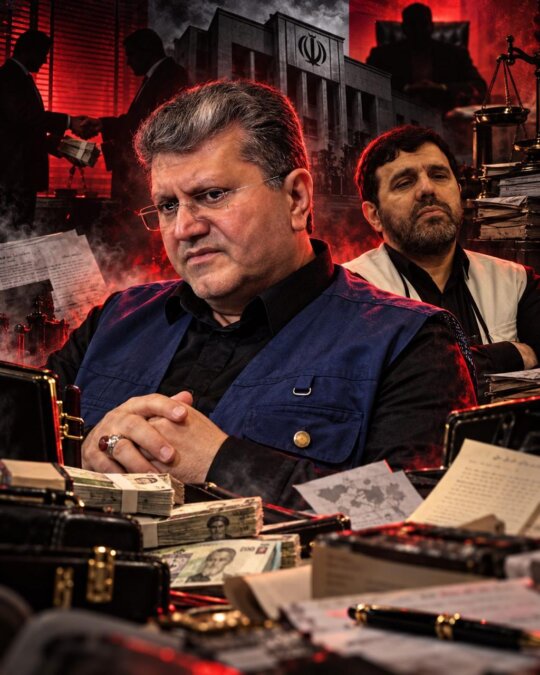
Mofid Amini, Ali Jabari, and Farshid Pourkavian have been implicated in the controversial case of illegal assistance with the costs of the Arbaeen insurance contract executor. The Minister of Economy must be accountable for this corruption and the lack of financial oversight over Iran Insurance. According to newly sent documents to the IranGate news agency about the 2026 Arbaeen pilgrims’ accident insurance contract, the manner of creating financial rent and corruption and the oversight mechanism on large contracts of the Iran Insurance Company have been exposed once again. The case involves Mofid Amini, the former CEO of Moallem Insurance and current board member of Iran Insurance, Ali Jabari, CEO of Iran Insurance, and Farshid Pourkavian. Claims have been made about the illegal allocation of hundreds of thousands of dollars to the operational costs of the contract executor, who happens to be a partner of Mofid Amini, increasing the necessity for oversight and security agencies to review the company’s board resolutions and documents. Based on the information provided to IranGate, during the execution of the individual accident insurance contract for Arbaeen pilgrims, valued at over five thousand billion tomans, an illegal credit of $400,000 was allocated for the daily costs of the contract executor, while the executor’s contract does not exceed five billion tomans. It is said that this decision was accompanied by the pressure of Amini, Jabari, and Pourkavian with the resolution of the Iran Insurance board. Another part of the information presented concerns Mofid Amini’s role in steering the Arbaeen insurance contracts in recent years at Moallem Insurance and his close economic ties with the annual Arbaeen contract executor. According to these documents, the execution of the contract was entrusted to an entity related to one of Amini’s economic partners, and subsequently, the issue of funding its operational costs was pursued with the support of some senior managers of Iran Insurance. The matter becomes more sensitive when, according to the provided information, the total actual costs of the contract’s executive team did not even reach five billion tomans, while the foreign currency credit in question, $400,000, equivalent to over one hundred billion tomans, was handed over to Mofid Amini. Furthermore, with Jabari’s support, no documents regarding the cost estimation and invoices have been provided by Amini and the contract executor to Iran Insurance. The importance of this case is not limited to the $400,000 figure. The use of resources from contracts related to the Arbaeen ceremony, due to the public and religious nature of this event, requires greater sensitivity in financial transparency. The connection of an economic contract with religious rituals cannot justify reduced oversight or neglect of the necessity for auditing, and any potential conflict of interest in such contracts must be thoroughly examined. Meanwhile, Seyed Ali Madanizadeh, the Minister of Economic Affairs and Finance, must immediately respond to the corruption of senior managers of Iran Insurance, as the only state-owned company, in front of the people, and oversee the financial performance of this company. The Ministry of Economy and related oversight agencies must immediately review the board resolution, payment documents, and economic relations of the individuals related to the contract and provide the public with the publishable results. The special $400,000 Arbaeen case could become one of the significant topics in uncovering corruption through the misuse of religious and spiritual themes in insurance contracts. A case that, once its precise dimensions are clarified, will begin the disclosure of other cases involving Jabari and his associates. The disclosure of corruption cases in Iran Insurance will continue.
