
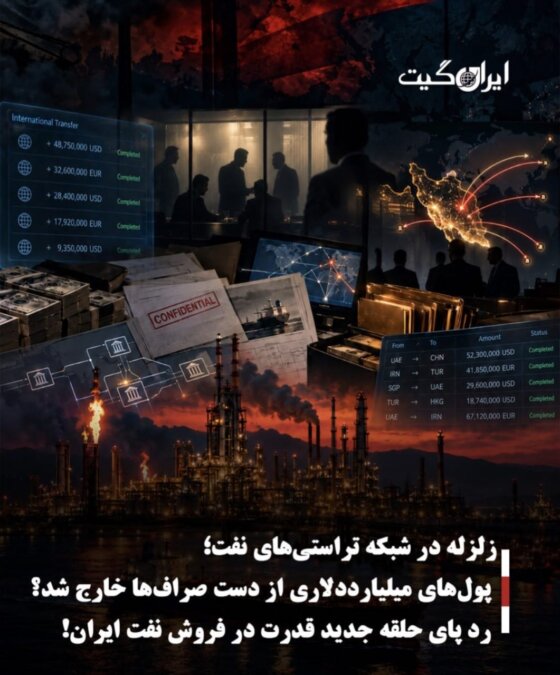
Earthquake in the network of oil trusties; billions of dollars slipped from the hands of money exchangers; traces of a new power circle in selling Iran’s oil.
The revelation of the billion-dollar networks of the Zaringhalam family, Sadaf Exchange, and intermediary companies in the UAE, Turkey, and Hong Kong has raised an important question about the future of Iran’s oil sales. Is the era of family trusties nearing its end, and will control of oil revenues be transferred to a more powerful circle? Mansour, Nasser, and Fazlollah Zaringhalam, three brothers whose names are tied to GCM, Brilliant, and Zaringhalam & Partners exchanges, according to the U.S. Treasury Department, were at the center of a network that transferred billions of dollars from Iran’s oil and petrochemical revenues through foreign companies. The family and business connections of this group are not limited to the three brothers; the names of Mitra, Pouria, and Farhad Zaringhalam also appear in investment records and related companies, although their roles and responsibilities differ. In 2026, the UK sanctioned the three brothers along with Pouria and Farhad. However, the main issue is not just the fate of the Zaringhalams. The bigger question is, after the exposure of this family’s financial routes and the Sadaf exchange network, who will fill their void in the structure of oil sales and currency transfers? An analysis of known connections suggests a significant scenario: old networks are not necessarily eliminated but might see power redistributed among the decision-makers of oil sales, commercial companies, and new financial entities. What happens behind the scenes of these shifts may be far more complex than just changing a few exchanges. The possibility of forming a new arrangement arises, where the main players are not necessarily the familiar names of the past. Reports on changing currency settlement routes and the use of Russian banking channels have fueled this hypothesis, although the definitive transfer of control from old networks to specific individuals has not yet been proven. The sensitive scenario is that while sanctions and exposures limit the old circles, new structures might take control of choosing agents, allocating oil shipments, and managing export revenues. If such a change is occurring, the revelation of the Zaringhalams and their related financial networks is not the end of the oil trusties’ case but the beginning of a new phase of power and money relations. In this equation, real power may no longer belong to the person whose name is on the exchange contract but to the entity that decides to whom the oil is assigned, through which path the money flows, and who is responsible for collecting the billion-dollar revenues. Perhaps the most important secret of this case is not the fate of the Zaringhalams but the names of those silently preparing to seize the economic position of the old networks, names whose identification could open a new chapter in behind-the-scenes investigations of Iran’s oil sales.