
Part Two
Emirati officials defend their role in expanding trade and investment in Africa
Nadim Koteich, a Lebanese-Emirati media manager and policy advisor, says the expansion of the UAE’s presence in Africa reflects the extraordinary importance this continent holds for the UAE’s post-oil era plans.
Koteich says,
Africa is one of the emerging lungs of the global economy. This continent is at the intersection of the Cold War between the United States and China, has an Arab-Islamic dimension, and the UAE needs not only to have a stake in Africa’s future but also to play a role in its stability and prosperity. What Abu Dhabi is building is not merely an investment portfolio but a system.
However, many African politicians who have been involved with Abu Dhabi are cautious and concerned about this approach.
Yemane Gebremeskel, Eritrea’s Minister of Information and the right-hand man of the country’s authoritarian President Isaias Afwerki, who does not have friendly relations with Abu Dhabi, says,
The problem with the UAE here in Africa is this inexplicable ambition to control the entire region.
Gebremeskel adds,
This process began with the attempt to dominate a series of satellite ports across East Africa, but now it seems to have turned into a much broader expansion of power and exploitation of resources.
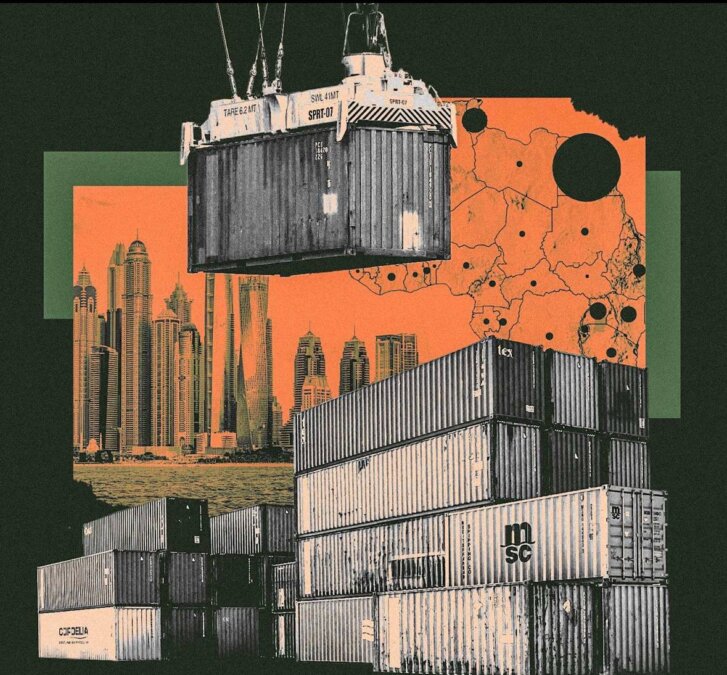
The UAE’s entry into Africa began with ports.
DP World, which emerged from Dubai’s efforts to become a global trade and logistics hub, acquired its first container terminal concessions in Africa in Djibouti, Maputo, and Dakar in the 2000s.
Since then, this logistics giant has aggressively expanded, leveraging trade between Africa, Asia, and the Middle East, connecting this trade flow to its logistics hub in Jebel Ali, Dubai, which is considered the largest man-made port in the world.
DP World, alongside the smaller logistics company Abu Dhabi Ports, established in 2006, now operates or is developing ports, inland terminals, and free zones in 13 African countries.
The company has acquired established distribution networks, including Imperial Logistics in South Africa and FMCG in Nigeria. With these actions, DP World plays a role in the movement of goods in over 25 African countries.
DP World’s logistics network flows through its main hub in Dubai, boosting trade. According to IMF statistics, the value of non-oil trade between Africa and the Gulf countries now exceeds 100 billion dollars, with a significant portion related to the United Arab Emirates and Saudi Arabia.
Eleonora Ardemagni, an Italian researcher and Gulf affairs specialist, describes ports as tools of influence at the heart of the UAE’s African policy.
However, Abu Dhabi’s increasing influence is not only through ports; money also plays a significant role, or at least the promise of it.
According to some estimates, the UAE has become the largest source of capital for Africa over the past decade.
According to fDi Markets, the Financial Times’ database for tracking cross-border foreign direct investment, the UAE has announced investments worth over 168 billion dollars since 2017.
Of course, these figures sometimes reflect the investor’s intent and ambition rather than realized outcomes.
A significant part of these investments is made through the International Holding Company (IHC), a 240 billion dollar company chaired by Sheikh Tahnoon bin Zayed Al Nahyan, the UAE’s National Security Advisor and brother of Mohammed bin Zayed (MBZ).
The UAE’s diverse projects on this continent are often announced with substantial valuations, including a 10 billion dollar wind farm in Egypt, a 4 billion dollar oil refinery in Uganda, and a 12 billion dollar port in Senegal.
Of course, not all projects are implemented. For example, regarding the 34 billion dollar green hydrogen production project in Mauritania, the German partner of this project told the Financial Times that the project’s implementation has been postponed due to challenging demand, and the UAE-backed investor has withdrawn from this contract.
Emirati officials say these investments demonstrate the country’s readiness to support African countries, countries where other investors are less inclined to enter due to risks.
Many African governments also welcome the influx of these investments, especially given that, according to the African Development Bank, the continent faces an annual infrastructure investment shortfall of 130 to 170 billion dollars.